Introduction
Have you ever listened to two Jamaicans speaking and thought, “Wait… are they even speaking the same language?”
One sounds almost like clear English, while the other feels fast, deep, and nearly impossible to follow. If that has ever happened to you, you are not alone.
Jamaican Patois is not a single fixed way of speaking. It exists on a spectrum. Linguists describe this using three main terms: acrolect, mesolect, and basilect.
To make this easier to understand, we can think of them in simple terms:
- Acrolect - Near-English Patois
- Mesolect - Everyday Patois
- Basilect - Deep Patois
The acrolect is closest to Standard English. The mesolect is the middle ground that most Jamaicans use in daily conversation. The basilect is the deepest form, often fast, expressive, and strongly rooted in African language patterns.
In Jamaica, people naturally move between these levels depending on who they are speaking to, where they are, and the situation. This shifting is part of what makes the language so dynamic and powerful.
Once you understand these levels, Patois stops sounding confusing and starts to click.
If you’re brand new to the language, it helps to first understand the basics of how Patois works. You can start with How to Speak Jamaican Patois (Complete Guide).
In this article, we will break down each level so you can hear the difference, understand it, and start using it with confidence.
Visual Breakdown
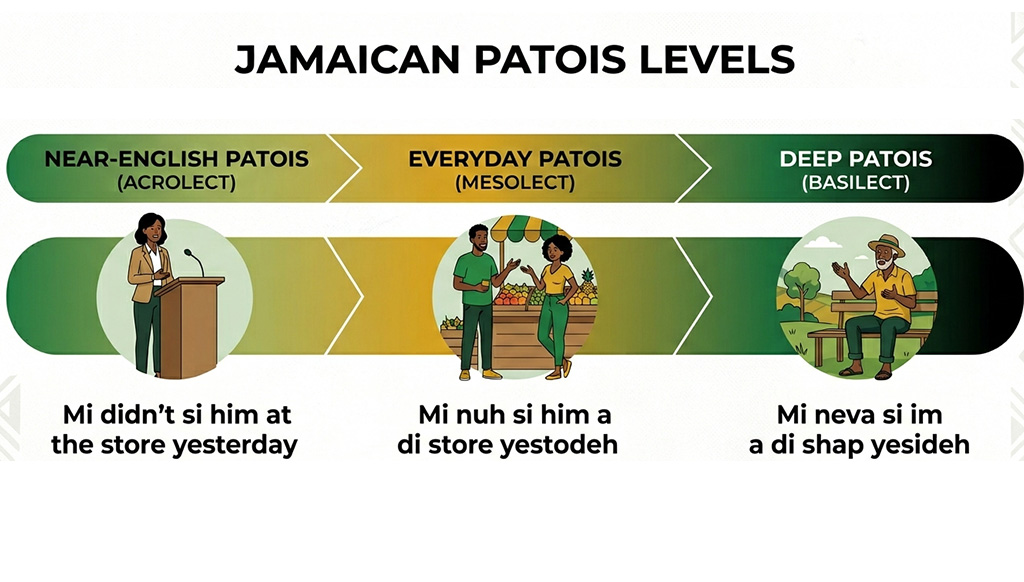
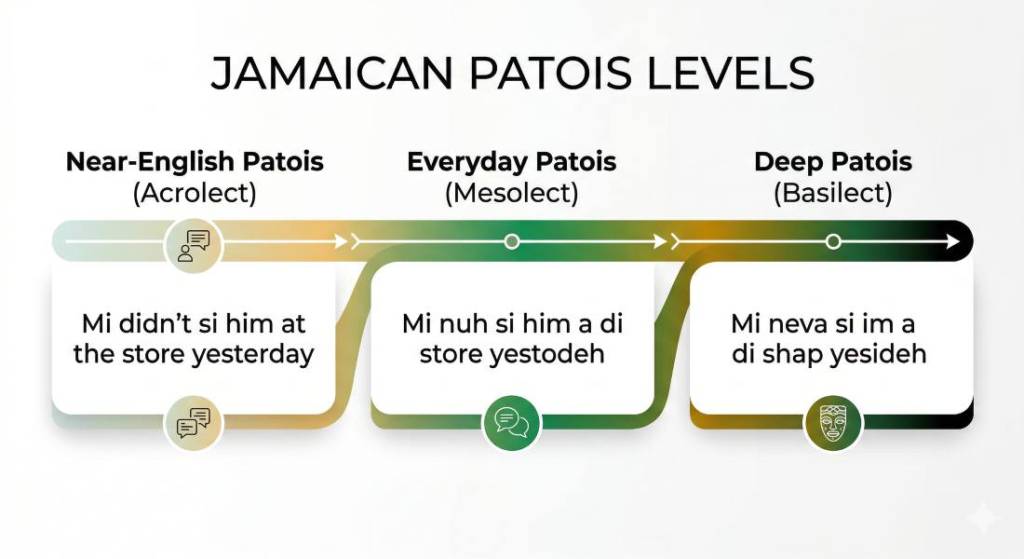 A simple visual showing how Jamaican Patois moves from Near-English Patois to Deep Patois
Think of Jamaican Patois like a spectrum:
Near-English Patois - Everyday Patois - Deep Patois
Here is the same sentence across all three levels:
- Near-English (Acrolect): Mi didn’t si him at the store yesterday
- Everyday (Mesolect): Mi nuh si him a di store yestodeh
- Deep (Basilect): Mi neva si im a di shap yesideh
Notice how the grammar gradually moves away from English, the vocabulary shifts, and the pronunciation becomes more natural and expressive as you move toward deep Patois.
Level 1: Near-English Patois (Acrolect)
Near-English Patois, also known as the acrolect, is the form of Jamaican speech that stays closest to Standard English. This is usually the easiest level for learners to understand because the sentence structure remains very similar to English, many English words are kept, and only a few Patois elements are introduced.
You will often hear this level in professional or formal settings, in conversations with tourists, and in environments like schools or workplaces where clarity matters. It is also common when Jamaicans adjust their speech so that non-native listeners can follow along more easily.
Example
Mi didn’t si him at the store yesterday
In this example, only a few elements change. “Mi” replaces “I,” and “si” replaces “see,” but the overall structure still follows English grammar. This makes it feel familiar, even for beginners.
Key Characteristics
- Strong English influence
- Clear pronunciation
- Minimal grammar changes
- Slower, more deliberate delivery
You can think of this level as a bridge between English and full Patois.
Important Insight
Many beginners assume this is what Jamaican Patois fully sounds like, but it is only one end of the spectrum. If you stop here, real conversations can still feel difficult to follow.
Level 2: Everyday Patois (Mesolect)
Everyday Patois, also known as the mesolect, is the level most Jamaicans use in daily life. This is the Patois you will hear on the street, among friends, at home, and in casual conversations.
At this level, grammar moves further away from English. Words are shortened, English rules are dropped, and the rhythm becomes more distinctly Jamaican. Even so, it remains very understandable once you get used to it.
Example
Mi nuh si him a di store yestodeh
Here, “nuh” replaces “didn’t,” and “a di” replaces “at the.” The structure is now fully Jamaican, even though the meaning is still clear.
Key Characteristics
- Balanced mix of English and Patois
- Natural Jamaican rhythm
- Noticeable grammar differences
- Most commonly used level
Important Insight
If you understand this level, you can understand most everyday conversations in Jamaica. This is the level that connects you most naturally to the culture.
If you want to hear more natural everyday usage, you can also explore 6 Ways to Greet and Respond like a Jamaican.
If you want to go beyond reading and start hearing and using these patterns, the How to Speak Jamaican Patois: Complete Beginner’s Guide Bundle is designed to help you build real sentence confidence step by step.
Level 3: Deep Patois (Basilect)
Deep Patois, also known as the basilect, is the most traditional and least English-influenced form of Jamaican speech. This is where the language becomes the most expressive, rhythmic, and culturally rich.
At this level, grammar is fully Jamaican, pronunciation shifts are stronger, and sentences are often faster and more compressed. For beginners, this can feel difficult at first, but it follows clear patterns that become easier with exposure.
Example
Mi neva si im a di shap yesideh
Here, “neva” replaces “didn’t,” “im” replaces “him,” and “shap” replaces “store.” Even “yesterday” shifts to “yesideh,” showing how sound drives the language.
Key Characteristics
- Minimal English structure
- Strong pronunciation shifts
- Shortened and compressed words
- Fast, expressive delivery
Important Insight
Deep Patois is not “broken English” or slang. It is a fully developed part of the language with its own rules, history, and structure.
Side-by-Side Comparison: Hear the Difference Clearly
Let’s look at all three levels together again:
- Near-English (Acrolect): Mi didn’t si him at the store yesterday
- Everyday (Mesolect): Mi nuh si him a di store yestodeh
- Deep (Basilect): Mi neva si im a di shap yesideh
Seeing them side by side helps you recognize patterns. The grammar shifts, the vocabulary changes, and the pronunciation becomes more natural as you move along the spectrum.
Once you start noticing these patterns, understanding Patois becomes much easier.
Why This Matters for Learners
Understanding these levels changes everything.
Instead of feeling like Jamaicans are switching languages, you begin to realize they are simply moving along a spectrum. This makes listening easier and removes a lot of frustration.
It also helps you avoid a common mistake. Many learners stay at near-English Patois and then feel lost in real conversations. Knowing that deeper levels exist prepares you for what you will actually hear.
Most importantly, it builds confidence. You do not need to understand everything at once. You just need to improve step by step.
How to Move Between Levels
Start with Near-English Patois so you understand basic structure. Then spend time listening to Everyday Patois, since this is the most common level. Focus on how sentences flow and how key words are used.
As you improve, begin exposing yourself to deeper Patois through music, conversations, and storytelling. Do not worry if you miss things at first. Over time, your ear will adjust.
A simple method is to take one sentence and observe how it changes across levels. This helps you understand the system instead of memorizing random phrases.
Conclusion
Jamaican Patois is not just one way of speaking. It is a flexible, living language that moves between Near-English Patois, Everyday Patois, and Deep Patois depending on the situation and the speaker.
Once you understand this, everything starts to make sense. What once sounded confusing becomes structured, and what felt random begins to feel natural.
Take your time with it. Listen carefully, practice consistently, and build step by step.
If you are ready to go deeper, the How to Speak Jamaican Patois: Complete Beginner’s Guide Bundle gives you a stronger path from basics to real usage.